“Technical Disruptions Are Being Reported on the Website, Including Data Identification Failures”: Additional Emergency Social Assistance Measure for Needy Families Forcibly Displaced from Nagorno-Karabakh Approved
In the context of social protection for persons forcibly displaced from Artsakh, on 10 April 2025, the Government of the Republic of Armenia adopted Decision No. 417-L, approving an additional emergency social assistance measure for needy families forcibly displaced from Nagorno-Karabakh. This measure replaces the support previously provided under Decision No. 1763-L of 12 October 2023, the discontinuation of which necessitated a new regulation.
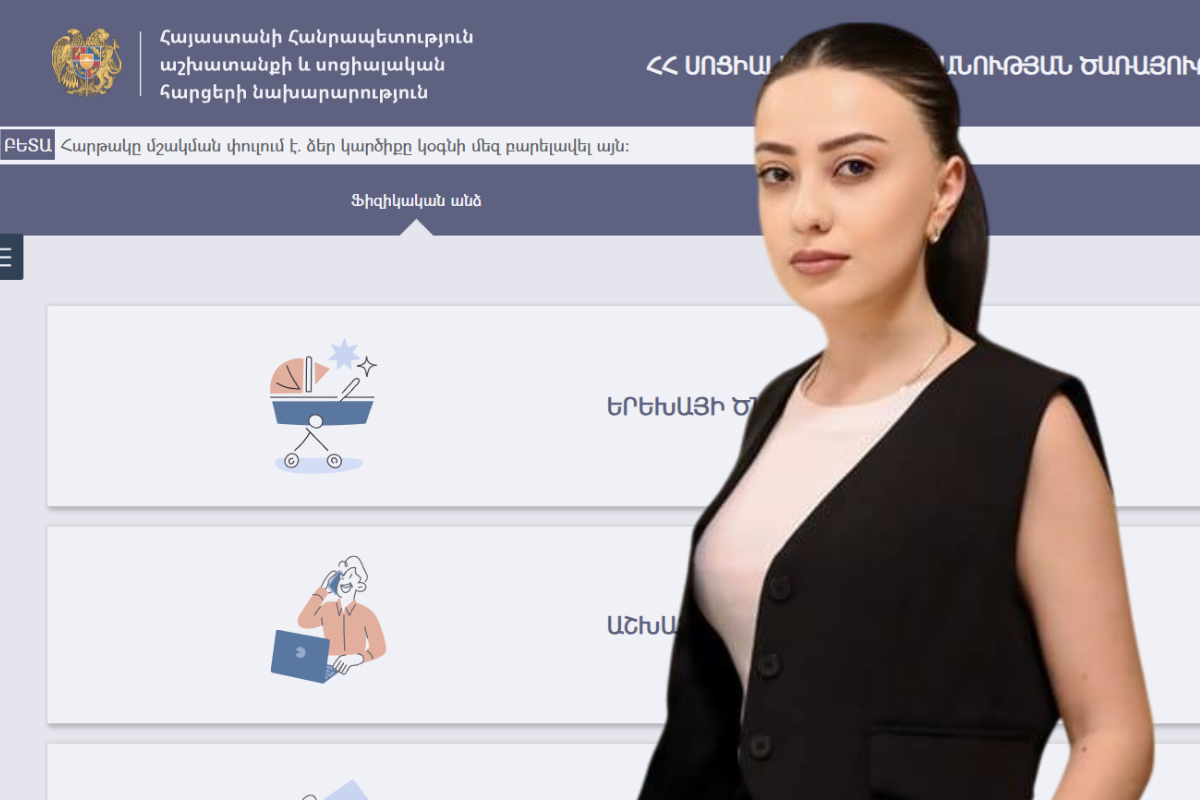
Applications are to be submitted through the e-social.am website, where each applicant must create an individual account and verify their identity through the State Population Register.
Marianna Avagyan, a lawyer with the CSO Network for the Protection of the Rights of Forcibly Displaced Persons from Artsakh, told Iravaban.net that a number of technical and administrative problems have emerged in practice.
“Users are reporting technical disruptions on the website, including data identification failures, inability to register, and rejections on the grounds that the declared actual place of residence does not match the address registered in the Population Register. This issue is particularly concerning because applicants were required to provide their actual place of residence, not their registered address. These two addresses do not always coincide,” she noted.
Marianna Avagyan explains that the amount of financial assistance stipulated by the decision—AMD 40,000 for the first forcibly displaced member of a family and AMD 10,000 for each subsequent member—is clearly inadequate in light of Armenia’s current socio-economic realities.
“This assessment is based on several objective factors, including:
- high residential rental costs, which significantly exceed the amount of assistance provided;
- cases of age discrimination in the labour market, which create particular difficulties for middle-aged and older people;
- the continuous increase in consumer prices, which makes socially vulnerable groups even more vulnerable,” she said.
According to the lawyer, these factors mean that the proposed assistance cannot effectively prevent the deterioration of beneficiary families’ socio-economic conditions or reduce the risk of their finding themselves in difficult life circumstances.
“Certain provisions of the decision also warrant analysis. In particular, the phrase ‘the first forcibly displaced member of the family’ is legally unclear and may give rise to different interpretations by both beneficiaries and state authorities. Furthermore, the decision restricts the range of persons eligible for assistance, including by limiting eligibility to families in which at least one member’s data appears in the lists compiled previously under Decision No. 1675-L of 3 October 2023 or in the lists maintained by the Operational Headquarters.
“This restrictive approach means that individuals who were in fact forcibly displaced but were not included in these lists due to technical or documentation-related obstacles are deprived of assistance, regardless of their actual needs. Such an approach contradicts the principles of legality, proportionality and universal accessibility in the field of social protection,” Marianna Avagyan emphasised.
According to her, this approach excludes individuals who were actually forcibly displaced from Artsakh but whose data were not included in the aforementioned lists for various reasons. “This problem has been repeatedly documented during the implementation of previous decisions, yet no legal solution has been provided,” she said.
The lawyer also notes that the draft lacks a clear definition of the term “family,” which may create problems in cases where family members do not live together or where the actual composition of a family differs from the officially recorded one. Given the special status of persons forcibly displaced from Artsakh, it is necessary to clarify who qualifies as a family member for the purposes of this measure.
“Summarising the observations outlined above, it should be emphasised that Armenia’s legal system already provides fundamental mechanisms for delivering social assistance. For example, the Law of the Republic of Armenia ‘On State Benefits’ is based on a multifactorial mechanism for assessing family vulnerability, which can ensure a more comprehensive and objective social assessment. However, in the case of persons forcibly displaced from Nagorno-Karabakh, a number of specific circumstances must be taken into account that are not characteristic of ordinary socially vulnerable groups.
“These individuals:
-
have effectively lost their primary sources of livelihood, including their property, homes and jobs;
-
are in an involuntary, unstable and uncertain situation as a result of forced displacement;
-
have a special status recognised under international law, which entails greater state responsibility for protecting their socio-economic rights,” Marianna Avagyan said.